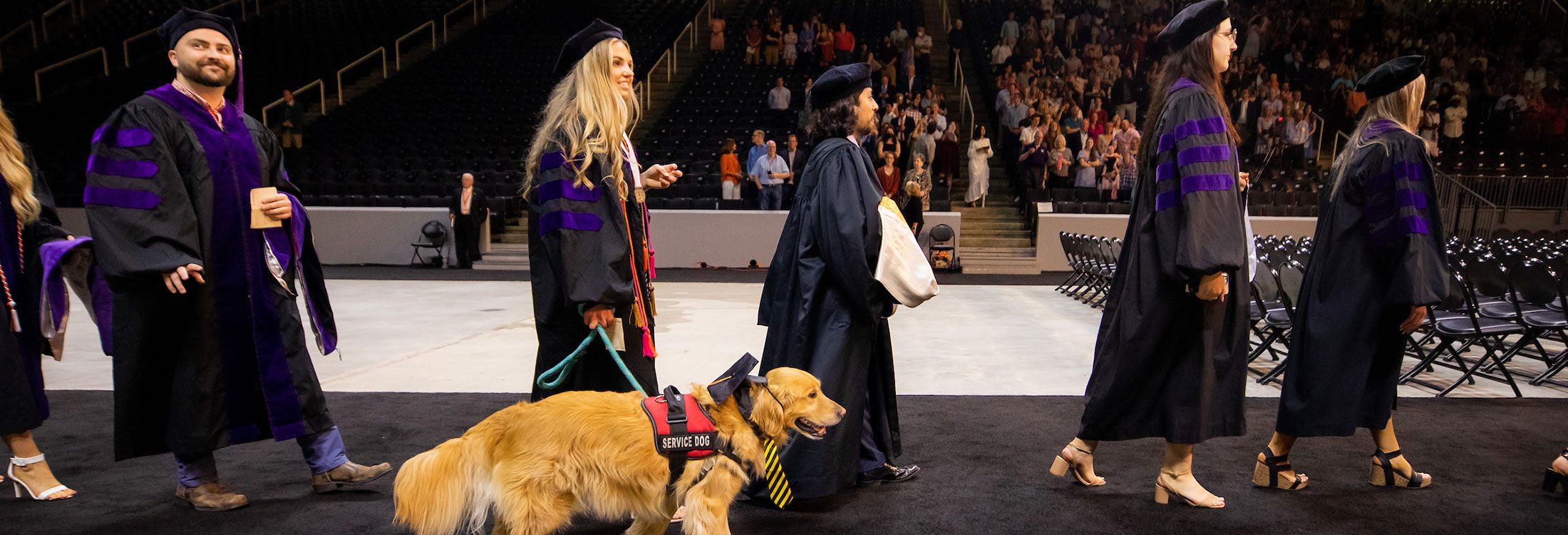
Students, staff, and faculty who may have service animals to assist with their disability are part of the University of Tennessee community. When the community lacks understanding about the role of service animals and how to appropriately interact with them, it creates unnecessary challenges for those with service animals who want to fully participate on campus. People often struggle to tell the difference between service animals, pets, or emotional service animals. Read on to learn more about identifying service animals, understanding their duties, and how to behave when a service animal is present.
What is a service animal?
Under the Americans with Disabilities Act, a service animal is defined as a dog that is individually trained to do work or perform tasks for a person with a disability, and the work or task must be related to the handler’s disability.
Any breed or size of dog can qualify as a service dog, as long as they have been trained to perform a job or task for a person with a disability. There is a minor provision that may allow for a miniature horse to be utilized as a service animal, but no other species can be defined as service animals under the law.
What questions can I ask an individual about their animal if I’m responsible for an area such as a classroom or office and I’m unsure if the dog is a service animal?
- Is the dog a service animal required because of a disability?
- What work or task has the dog been trained to perform?
You cannot ask about a person’s disability, require medical documentation, require a special ID card or training documentation for the dog, or ask that the dog demonstrate its ability to perform the work or tasks.
New Service Animal IDs
Student Disability Services (SDS) and Equal Opportunity and Accessibility (EOA) have partnered with the VolCard office to offer students, staff, and faculty the option of purchasing a physical UTK identification card for their service animal.
Students may complete a brief online request with SDS if they are interested, and staff and faculty may contact EOA by emailing eoa@utk.edu. Once verified, SDS and EOA will notify the VolCard office that an ID may be issued.
While the identification card offers a simple way to demonstrate that your animal has been verified by SDS or EOA, it is completely optional. Students, staff, and faculty with service animals still have a legal right for their animal to accompany them on campus if they choose not to obtain a card.
By law, service animals must generally be permitted to accompany people with disabilities in all areas where the public is allowed to go as long as they are under control and are housebroken. This includes restaurants, stores, schools, hotels, and even hospitals and doctor’s offices.
It’s common to assume that a service dog has to complete professional training, obtain certification, and wear a vest to be considered a service animal under the protections of the law. However, none of that is required. There are even entities that sell “certifications”, insinuating that this is required in order to use a service animal in public spaces. However, there is no legally recognized certification for service animals, and certification of any kind is not required.
While service animal training organizations exist and can be very beneficial, professional training is not required. People with disabilities are permitted to train their own service animals and can often do so very effectively. Also, service animals are not required to wear any sort of vest or collar that identifies them as a service animal.
A service animal must be under the control of its handler. The ADA specifically says, “Service animals must be harnessed, leashed, or tethered, unless the individual’s disability prevents using these devices or these devices interfere with the service animal’s safe, effective performance of tasks. In that case, the individual must maintain control of the animal through voice, signal, or other effective controls.”
A service animal may not exhibit disruptive behaviors, such as excessive barking, and it must be housebroken. If an animal is out of control, and the handler does not take effective action to regain control, the animal may be excluded from the premises.
A service animal cannot be excluded because of the potential for fear of dogs or allergies. Students or staff who have disabilities they feel may be exacerbated by the presence of a dog in a campus area they must frequent may contact SDS or EOA, respectively, to discuss options.
Keeping in mind that services animals are not required to wear a vest or other identification, it’s always best to ask someone before you engage with their dog. If you know a dog is a service animal, you should not talk to it or touch it, because the animal is working and is not a pet. It’s still okay to ask a handler if you may pet their service animal, but do not be surprised or offended if they say no.
It is very important that individuals who are permitted to have a non-service animal on campus under provisions of the University of Tennessee animal policy maintain control of their animal so it does not interact with a service animal nor interfere with their work.
Service animals in training are not afforded rights by the Americans with Disabilities Act. However, in the State of Tennessee, service animals in training are permitted in places of public accommodation as long as they are accompanied by a handler who is training the dog on behalf of an accredited school that trains service animals to assist people with disabilities. The trainer must first present credentials from the school before being permitted. They must also keep the dog on a leash at all times. The animal must be wearing apparel that includes the identity of the training school.